I have always wondered how rockets could fly in space, as we all know oxygen is needed for combustion, but there is no oxygen is space. So I researched about this topic, and came up with some interesting results.
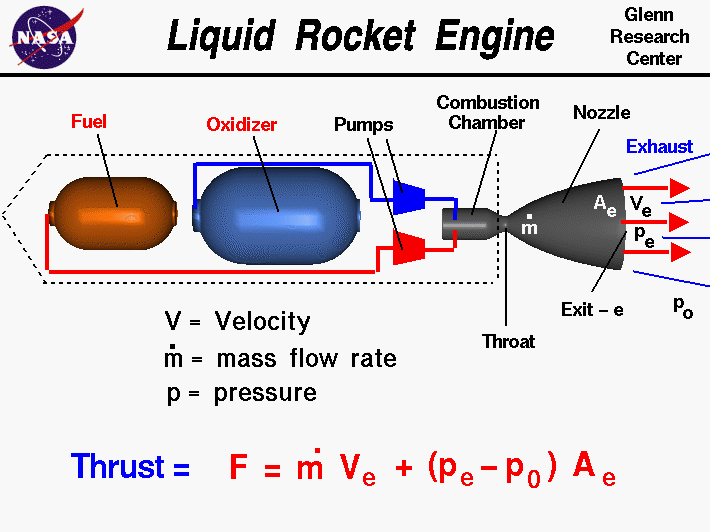
I found out that in a rocket's engine, a fuel propellant is burned with an oxidizer propellant to produce large volumes of very hot gas. The hot gas that is ejected from the rocket engine acts as a propellant, and produces thrusts for the rocket, to make it move. The hot gases that are ejected from the engine expand accelerates them until they rush out of the back of the rocket at extremely high speeds, propelling the rocket forwards. During takeoff, however, the rocket makes use of its liquid hydrogen and oxygen tanks to boost themselves out of the Earth's gravitational field.
Tuesday, August 24, 2010
Wednesday, August 4, 2010
Iodine- What it can do
only react and turn blue-black when it comes into contact
with plant products.
Sunday, August 1, 2010
Cells- What I learnt
Today, I have learnt a lot of information about cells, both animal and plant. Firstly, I have learnt that animal cells differ from plant cells greatly, as they lack the presence of a few cell parts. A plant cell has the basic cell parts of - the sap vacuole, the cell wall, the nucleus, the cytoplasm, the cell membrane and the chloroplasts, while an animal cell has the basic cell parts of - many small vacuoles, the nucleus, the cytoplasm and the cell membrane. Other than these parts, plant and animal cells also contain other parts which are more complicated, such as the smooth and rough endoplasmic reticulum, the ribosomes, mitochondria, golgi body, etc. Below is an explanation of the various cell parts as mentioned above-
Sap Vacuole/Small Vacuoles- Stores water, nutrients, and other substances that are not immediately used. It takes up most of the space in a typical plant cell, however, it is small and there is the presence of a few of it in typical animal cells. It stores compounds and helps in plant and animal growth.
Cell Wall (Plant Cell)- Made up of cellulose, and it provides structural support for plant cells. It helps to maintain the cell's rigid shape and it also controls the maximum amount of water that is taken into the cell.
Nucleus- It contains chromosomes, structures made up of genetic information,and is essential for cell division. It regulates other cell activity.
Cytoplasm- It distributes food and oxygen to other parts of the cell, and it fills up and supports the remaining empty spaces left in the cell. It contains mostly dissolved nutrients.
Cell Membrane- It is a semi-permeable layer around the cell which allows waste materials to exit the cell, and allows only certain substances to enter the cell.
Chloroplasts (Plant Cell)- They are found in numbers in plant cells, and store chlorophyll, which is needed for photosynthesis. They are the food producers for the cell.
These are the various basic parts and their functions of plant and animal cells, and they each have their own significance. In cells, 'division of labour' means that each part of the cell has its own specific function, and this will make them specialize in their task and thus, efficiency is increased.
Sap Vacuole/Small Vacuoles- Stores water, nutrients, and other substances that are not immediately used. It takes up most of the space in a typical plant cell, however, it is small and there is the presence of a few of it in typical animal cells. It stores compounds and helps in plant and animal growth.
Cell Wall (Plant Cell)- Made up of cellulose, and it provides structural support for plant cells. It helps to maintain the cell's rigid shape and it also controls the maximum amount of water that is taken into the cell.
Nucleus- It contains chromosomes, structures made up of genetic information,and is essential for cell division. It regulates other cell activity.
Cytoplasm- It distributes food and oxygen to other parts of the cell, and it fills up and supports the remaining empty spaces left in the cell. It contains mostly dissolved nutrients.
Cell Membrane- It is a semi-permeable layer around the cell which allows waste materials to exit the cell, and allows only certain substances to enter the cell.
Chloroplasts (Plant Cell)- They are found in numbers in plant cells, and store chlorophyll, which is needed for photosynthesis. They are the food producers for the cell.
These are the various basic parts and their functions of plant and animal cells, and they each have their own significance. In cells, 'division of labour' means that each part of the cell has its own specific function, and this will make them specialize in their task and thus, efficiency is increased.
Saturday, July 3, 2010
What I Know About Aerobic and Anaerobic Respiration
After being introduced to studying a little on this topic, I became interested to find out more on aerobic and anaerobic respiration. First of all, I have learnt that both of the respiration processes are different in their own ways. In both processes, ATP, or adenosine triphosphate, is involved.
Aerobic Respiration
Aerobic respiration occurs in plants, and scientifically speaking, it is the release of energy from glucose or another organic substance in the presence of oxygen. During aerobic respiration, oxygen is required, and the process is divided into two processes: the Krebs cycle, and the Electron Transport Chain, which produces ATP. The molecules are reduced, receiving high energy electrons, thus representing energy available to do work.
Anaerobic Respiration
This process is very different from aerobic respiration.In anaerobic respiration, organisms produce usable energy in the form of ATP without the presence of oxygen. In other word, it is respiration without the need of oxygen. These organisms are usually bacteria or other micro-organisms which live in environments which lack the presence of oxygen. However, even though oxygen is not involved in this process, it is still a form of respiration, because all three basic steps of respiration are used- glycolysis, the citric acid cycle, and the respiratory chain.
These are the two different forms of respiration, and their differences can be seen from the points stated above.
Aerobic Respiration
Aerobic respiration occurs in plants, and scientifically speaking, it is the release of energy from glucose or another organic substance in the presence of oxygen. During aerobic respiration, oxygen is required, and the process is divided into two processes: the Krebs cycle, and the Electron Transport Chain, which produces ATP. The molecules are reduced, receiving high energy electrons, thus representing energy available to do work.
Anaerobic Respiration
This process is very different from aerobic respiration.In anaerobic respiration, organisms produce usable energy in the form of ATP without the presence of oxygen. In other word, it is respiration without the need of oxygen. These organisms are usually bacteria or other micro-organisms which live in environments which lack the presence of oxygen. However, even though oxygen is not involved in this process, it is still a form of respiration, because all three basic steps of respiration are used- glycolysis, the citric acid cycle, and the respiratory chain.
These are the two different forms of respiration, and their differences can be seen from the points stated above.
Thursday, June 3, 2010
Post on my feelings towards the recent Gulf of Mexico's oil spill
On the 20th of April, 2010, a sea-floor oil gusher, the Deepwater Horizon drilling rig, run by British Petroleum company exploded due to a malfunction, resulting in the deaths of 11 platform workers and the injury of 17 others. Apart from the deaths and injury, the explosion of the oil rig, caused the Gulf of Mexico oil spill, also referred to as the Deepwater Horizon oil spill. It is the largest marine oil spill in the history of the petroleum industry, as lots of gushing crude oil was emitted from the wellhead (an estimated amount of 53000- 62000 barrels of oil per day). The oil spill caused a lot of damage to the wildlife and marine habitats and also caused the fishing and tourism industries in the Gulf of Mexico to lose business. Many dead fish and turtles have been found along the shores and beaches around the area, as well as birds, including pelicans, with oily and wet wings, faltering their flight. Moreover, the water in the affected area was brown and sticky, affecting the tourism and restaurants in the Gulf, which had seafood on the menu. Most of the marine life was badly affected by the oil in their habitat, and few dared to have seafood at restaurants in the Gulf. Other than the affected marine life, the oil wasted was also in large quantities, which meant a heavy loss of financial capital from the British Petroleum. The BP, being held responsible, has taken a few actions so far. They had shut down the oil well since the 15th of July and they are undergoing operations to remove the drill pipe. Also, after the leak had been spewing for nearly three months, the BP capped the well. They have also launched the test to assess possible damage to the well pipe which runs nearly four kilometers under the sea floor. I feel that these measures taken are helping to solve the problem, and it is good that the BP is implementing these solutions. I hope that the problem will be solved soon, the Gulf waters will return to normal, and that the marine life do not die.
Subscribe to:
Posts (Atom)

